
TL;DR: A policy acknowledgement records that a named employee declared they had read a specific version of a policy, on a specific date. It does not prove they actually read or understood it.
When an auditor asks for evidence, you need more than a tick box. You need to know which policy they accepted, who was asked, who has completed it, who hasn’t, and whether the record still exists when someone leaves.
For important policies, add a short quiz to check understanding. When the wording changes, ask staff to acknowledge the new version.
Claromentis Policy Management helps organisations manage policy versions, employee acknowledgements, reminders and acceptance reporting in one place.
Sooner or later, someone asks you to prove it.
An auditor, insurer, client or employment adviser wants to know whether a named employee had acknowledged a particular policy before something went wrong.
You open the policy folder. Then the spreadsheet. Then the email reminders.
And somewhere in that process, you need to establish which version the employee received, whether they acknowledged it and whether the record still exists. That is where policy acknowledgement becomes more than a tick box.
For seven years I ran Claromentis, as the customer, for more than 850 people across 20 countries. Today I sell it as the founder of Techspire IT, an Authorised Claromentis Partner.
This guide explains what a policy acknowledgement actually proves, what evidence you need and how to manage the process without relying on scattered emails and spreadsheets.
Key Takeaways
- A policy acknowledgement records what an employee declared, not whether they actually read the policy.
- Every acceptance should be tied to the person, policy version and date.
- A proper process should show who has acknowledged a policy and who still needs to.
- Important policies may need a short quiz to check understanding.
- When a policy changes, employees may need to acknowledge the new version.
- Acceptance records should remain available when employees leave.
- Claromentis Policy Management helps manage acknowledgements, versions, reminders and acceptance reporting.
Interactive: Could you prove it today?
Six things an auditor asks for
An auditor asks for evidence that your employees acknowledged a policy. Could you show the policy version, who accepted it, who hasn't and the record for one team? Check what you could provide today. Nothing is sent.
0 of 6 ready to hand over
What to do next
One more: would a leaver's record survive? Check what happens to the record before you delete the account.
See the record kept for you in a 30-day portalWhat is a policy acknowledgement?
A policy acknowledgement is a dated record that a named person declared they had read a named version of a policy. Most policy systems capture it as a tick box and a Submit button at the foot of the policy. On paper, instead, it’s a signature on a form, kept in a file.
Policy attestation means the same act. However, compliance teams tend to use that word for the yearly check, when staff confirm again that they still follow a policy they accepted before. You’ll also hear “sign-off” and “read and accept”, and Claromentis calls it acceptance. This guide uses the words for the same thing.
Three details turn a policy acknowledgement from a gesture into evidence:
- The person, tied to their own login or signature.
- The version, so you know which wording they accepted.
- The date and time, so you know they accepted it before the thing went wrong.
If you lose any one of those details, the record becomes harder to use as evidence.
And if your organisation is managing policies across several departments, the problem becomes bigger than recording one person’s acceptance. You also need to know who must acknowledge each policy, who has completed it and what happens when the policy changes. That is where a policy management system becomes useful.
If you’re still working out why staff ignore policies in the first place, our guide to why employees ignore company policies starts there. This guide focuses on what happens once the policy exists and you need to manage the acknowledgement process.
What does an auditor ask when they want proof?
They ask six questions, and email struggles with most of them. Security frameworks set the same bar. NIST SP 800-53, the US government’s catalogue of security controls, asks for a documented acknowledgement before someone gets access. It also asks for a fresh one when the rules change (NIST, SP 800-53 Rev. 5, 2020).
| The auditor asks | Where email or a signed sheet struggles | What a policy system keeps |
|---|---|---|
| 1. Which policy, and which version? | “Agreed” replies to an attachment that has changed since | A reference, an owner and numbered versions, with old ones archived |
| 2. Who was asked? | The distribution list lives in someone’s inbox | The list of people who must accept, set on the policy |
| 3. When did each person accept? | Dates scattered across replies and folders | A date and time against each person and version |
| 4. Who hasn’t, and what did you do? | The silent ones are hard to list | Who has and hasn’t accepted, and a reminder to those who haven’t |
| 5. Can you show one team, across every policy? | One spreadsheet per policy | One report by person, role or group, downloadable |
| 6. When was it last reviewed? | Often unclear | A review date on every policy, with reminders |
The first three questions establish what was acknowledged, by whom and when. The remaining questions establish whether the organisation is managing the process.
That distinction matters. A record of acceptance is useful, but it does not tell you whether everyone who needed to acknowledge the policy actually did so. You also need a way to identify outstanding employees, report across a team and keep policy reviews from slipping.
For organisations managing several policies, those tasks become difficult to coordinate manually. Claromentis Policy Management brings policy versions, acknowledgement status, reminders and reporting into the same process.
Does a policy acknowledgement prove someone read it?
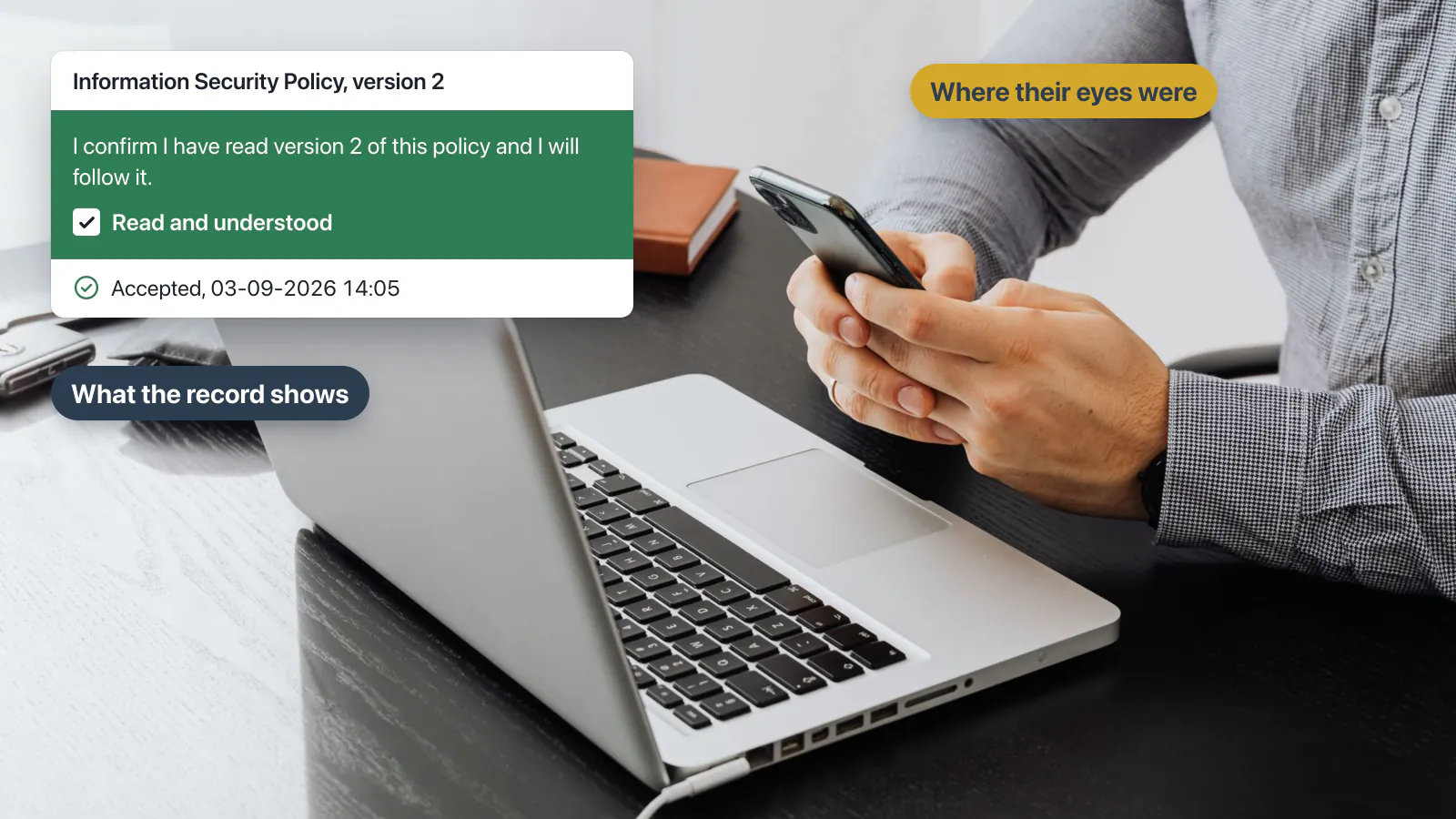
No. It proves they said they did. No system can see whether a person read a page before ticking the box, and Claromentis is no exception. The tick records the person’s word, with a date, so the duty to read sits with them.
Tools that time how long a page stayed open don’t change that, because they measure an open browser tab, not attention.
That isn’t a weakness to hide. In fact, it’s what the frameworks ask for. NIST’s wording asks people to confirm they “have read, understand, and agree to abide by” the rules (NIST, SP 800-53 Rev. 5, 2020). That’s a declaration, and a dated declaration is useful evidence. It shows you told the person, gave them the text and had them confirm it.
The important thing is to describe the record honestly. It shows that a person acknowledged a specific version of a policy on a particular date. It does not prove that they understood every requirement.
If you need evidence of understanding, add a short assessment. And if you need to manage acknowledgements across a workforce, you need to be able to see which employees have completed the process and which have not.
When should you test understanding as well?
When a mistake would hurt someone or cost a fine. Health and safety, data protection, safeguarding and information security are the usual candidates. For those, add a short quiz straight after the acceptance, with a pass mark. A pass shows the person understood the main points on that day, which a tick never can.
Keep it short. For example, five questions on the rules people actually break will tell you more than twenty on the definitions.
For policies where understanding matters, Claromentis also provides a Quiz application. A quiz is not a replacement for acknowledgement. The acknowledgement records the employee’s declaration. The quiz checks their understanding of the policy.
For organisations that already use Claromentis for learning, a quiz can also sit inside a course as one of its modules. Our AI usage policy guide shows one beside the policy it tests.
Claromentis AI can also help employees find answers from policy content, where the relevant AI features are configured. That can make policies easier to use. However, an AI answer is not evidence that someone acknowledged the policy or understood it. Keep acknowledgement and assessment as separate parts of the process.
What should a policy acknowledgement say?
Say exactly what the person is declaring, in plain words, and tie it to the version. Here’s wording you can adapt:
I confirm I have read version 2 of the Information Security Policy. I understand it applies to me and I will follow it. If anything is unclear, I’ll ask my manager before I act.
The wording should match what you actually need employees to declare. “I have read” records acknowledgement, “I understand it applies to me” makes the scope clearer and “I will follow it” adds a commitment.
Keep the declaration proportionate to the policy. Do not ask employees to declare that they understood a lengthy document if the process gives them no reasonable opportunity to read it. Whether you can require staff to agree with a policy, as well as acknowledge it, is a question for your employment adviser, not a blog.
In Claromentis, the acknowledgement wording can be configured for the policy. The acceptance is then recorded against the policy version. On a paper form, make sure the version is recorded alongside the declaration.
What happens to acknowledgements when a policy changes?
A policy acknowledgement belongs to the version the employee was asked to accept. If the wording changes, you need to decide whether the change requires employees to acknowledge the new version. For important changes, the new version should have its own acceptance record. That allows you to establish which wording an employee acknowledged.
In Claromentis, Policy Management supports policy versions, archived versions and employee acknowledgements. When an editor creates a new version, the old one moves to the archive with its acceptances intact, and you can notify everyone who must accept the new one. The policy owner still needs to decide which employees must accept the updated policy and whether the change requires a new acknowledgement. Check that list before you publish, because each version carries its own.
Two publishing and configuration choices matter here, and neither sorts itself out:
- A big change made as a small one. Claromentis lets an editor fix spelling or layout in a live policy without a new version, unless an administrator turns that off. Anything bigger than a typo belongs in a new version, or the old acceptances no longer match the text.
- A body that changes underneath you. A policy whose body is a live file from the Documents application shows whatever that file says today. For a policy people must accept, keep the body in the policy itself, so each version stays fixed.
The same principle applies to external policies. If employees are expected to acknowledge a policy, make sure the acknowledgement is recorded in the process you use to manage it. Do not assume that a link to another website creates an acknowledgement record in your intranet.
What happens to a policy acknowledgement when someone leaves?
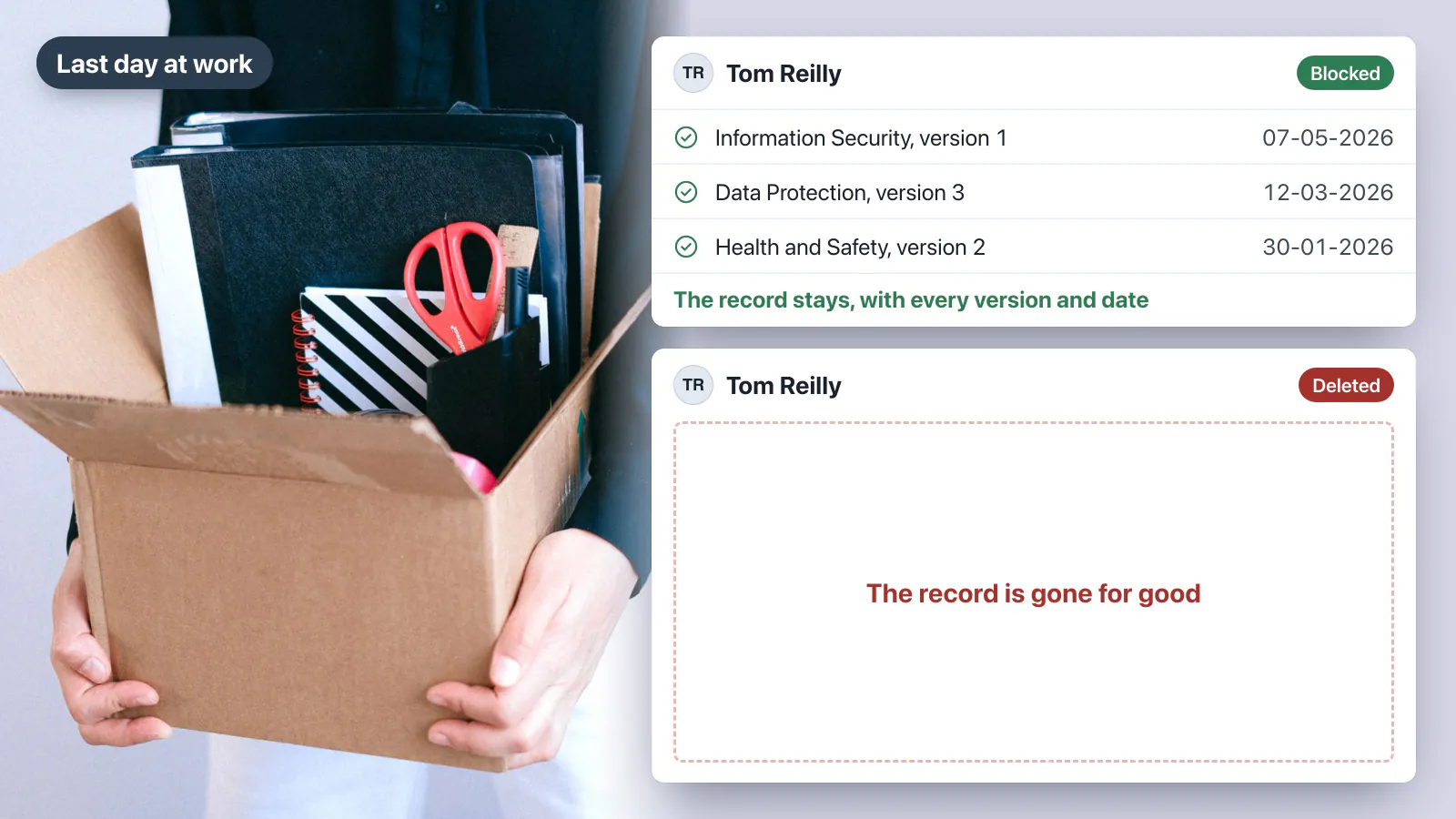
When someone leaves, their policy acknowledgement history may still be needed. An organisation could need the record to establish which policy the employee acknowledged and when.
In Claromentis, deleting a user permanently removes their policy acceptance history, while blocking the account keeps it. So decide whether you need the record before you delete anyone.
However, keeping the record is not the same as keeping it forever. Policy acknowledgement records contain personal data. The organisation should establish an appropriate retention period and apply it consistently.
Include policy acknowledgement records in the HR and IT leaver checklist.
Which other gaps break the record without anyone noticing?
Three more, and each one looks fine until an auditor asks.
- People added later aren’t told. In Claromentis, someone added to the list for a live policy gets no notification of their own, so send a reminder after you add them.
- The list is set on each policy. You can’t set who must accept for a whole category at once, so make it part of the publishing checklist.
- The activity log isn’t the evidence. Claromentis keeps an audit log for investigations, and commonly only the last 30 days stay searchable on screen. Hand an auditor the acceptance report, not the log.
These are process gaps, not simply software problems. A policy acknowledgement system helps manage the process, but the organisation still needs clear ownership. Someone must decide who needs to accept the policy, check outstanding acknowledgements and ensure the policy is reviewed when required.
How do you show policy acknowledgement evidence for one team?
When an auditor asks for the acknowledgement history of one team, you need to produce the record without assembling it manually from several policies. In Claromentis Policy Management, the acceptance reporting process lets authorised users review acknowledgement status across policies. You can identify employees who have accepted and those who are still pending. For an individual policy, the acceptance status also helps identify who needs a reminder.
The important point is that the report should answer the question the auditor asked. It runs for one person, or a whole role or group, and downloads as a CSV file. Only people with the right permission can see it, because it’s personal data about your staff.
Then the sixth question: when did you last review it? Give every policy a review date. In Claromentis, the people who can edit the policy get a reminder 15 days before and another on the day. In version 11, an administrator can also set a default review period, so no new policy goes without one.
Inside Claromentis: one policy across its versions
A policy acknowledgement is useful only when you can connect it to the wording the employee was asked to accept. In this sample demonstration, you can see the acknowledgement, the employee’s acceptance history and the earlier policy version. The record shows which version Tom accepted and whether he has acknowledged the newer one.
Watch: the acceptance, the history and the archived version
One policy across its versions: the acceptance box, the acceptance history and the archived version
How we keep company data and systems safe.
Purpose
This policy sets out how we protect company information, and what every member of staff must do.
The acceptance box at the foot of the policy
I confirm I have read version 2 of the Information Security Policy. I understand it applies to me and I will follow it.
Information Security Policy read and understood SubmitThe acceptance history, version by version
Version 2 of the policy, with your own wording at the foot.
An illustration of Policy Manager in Claromentis, redrawn from our demo portal with a sample policy and sample people, 31 October 2026.
Claromentis Policy Management also supports policy versioning, review dates, reminders and acceptance reporting.
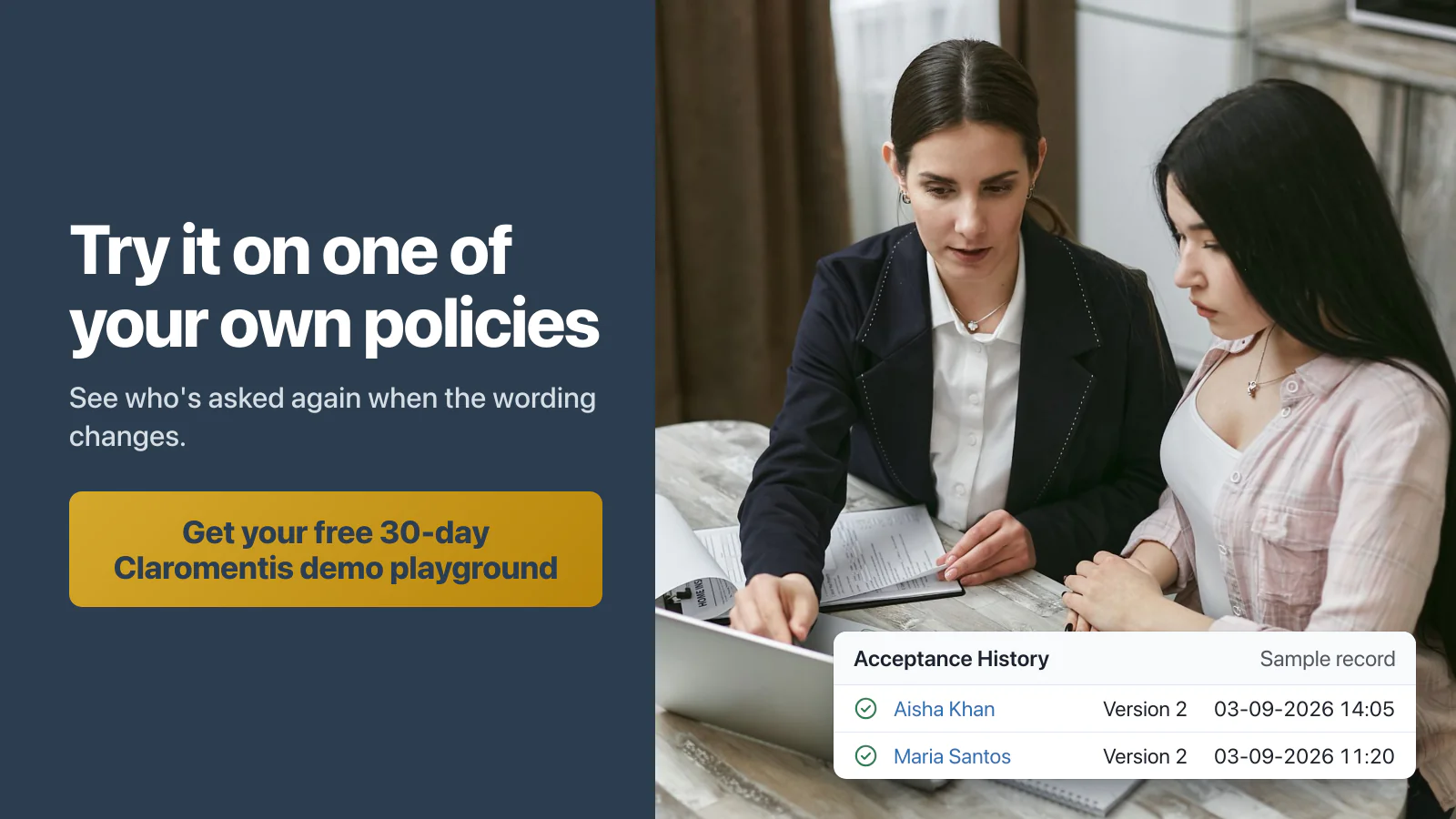
You can explore the same process using a policy in your own free 30-day Claromentis demo playground.
Can you do this with email, a form and a spreadsheet?
For a small team with a handful of policies, email, a form and a spreadsheet may be enough. The difficulty appears when you need to manage several policies across different teams. Someone has to maintain the version list, chase outstanding employees, preserve the records and produce a report.
| Job | Email or a signed sheet | A form and a spreadsheet | A policy system |
|---|---|---|---|
| Tie each acceptance to a version | Rarely | If you add a version column | Built in |
| Chase only the people who haven’t | By hand | By hand, after a lookup | One button |
| Keep the record after a leaver | If nobody clears the folder | If nobody deletes the row | Yes, if you block rather than delete |
| One report for a team, across policies | No | One sheet per policy | Built in |
| Remind you to review | No | A calendar entry | Built in |
If your organisation already uses Microsoft 365, it is worth considering what you can manage with the tools you already have. The question is whether your existing process gives you a reliable way to manage policy versions, employee acknowledgements, outstanding tasks and reporting. Our guide to whether you need an intranet alongside Microsoft 365 explains that decision. Claromentis becomes relevant when you want policy management alongside a wider employee intranet.
Frequently asked questions
These are the questions organisations commonly need to answer when setting up a policy acknowledgement process.
Is attestation the same as acknowledgement?
Yes. Both mean a person confirms, on record, that they’ve read a policy and will follow it. “Attestation” often means the yearly check.
Does acknowledging a rule mean agreeing with it?
Not on its own. It means the person confirms they received and read it. Whether you can require agreement is a question for your employment adviser.
What should an acknowledgement form include?
The person’s name, the policy’s title and version, the date, and the words they’re declaring, such as “I have read and understood this policy and will follow it.”
How often should staff confirm a policy again?
When its wording changes in a way that matters, and once a year for policies where a lapse would be serious.
Do staff need to sign, or is a tick enough?
A tick is enough for NIST, whose control catalogue counts electronic check boxes as documented acknowledgements (NIST, SP 800-53 Rev. 5, 2020). Where a document forms part of someone’s contract of employment, ask your employment adviser what it needs.
The bottom line on proving staff have read a policy
Strictly speaking, you cannot prove that someone read every word. What you can establish is that a named employee declared they had read a specific policy version, on a particular date.
For important policies, add a short quiz to check understanding. When the wording changes, manage the new acknowledgement. When employees leave, make sure the records are retained according to your organisation’s requirements. And when an auditor asks for evidence, make sure you can identify who accepted the policy, who hasn’t and which version they were asked to acknowledge.
That is the difference between collecting a tick and managing policy acknowledgement. Claromentis Policy Management helps organisations manage policy versions, acknowledgements, reminders and acceptance reporting in one place.
Try policy acknowledgement on one of your own policies
You have seen what a policy acknowledgement needs to record. Now test the process using a policy your employees actually need to acknowledge.
In the free 30-day Claromentis demo playground, you can explore:
- Creating a policy.
- Managing its versions.
- Recording employee acknowledgements.
- Reviewing acceptance history.
- Seeing how outstanding acknowledgements are managed.
Bring one policy and the questions your organisation needs to answer. See how Claromentis manages the process.
Techspire IT is an Authorised Claromentis Partner. We can help you assess whether Claromentis Policy Management fits your organisation and how it could work alongside your intranet.
How we researched this
On 29 October 2026 we captured Google’s results for “policy acknowledgement” (US and UK), “policy acknowledgment”, “policy attestation” and “policy acknowledgement form” (US), “how to prove employees have read a policy” and “policy sign off” (UK), leaving out LinkedIn, Facebook, YouTube, Scribd and Reddit. Of the 50 top-ten pages, 45 loaded; we searched each for set phrases and read the near misses by hand. Nearly half, and all seven AI Overviews, describe an acknowledgement as staff confirming they’ve read and understood a policy. None we could find says the record proves what the person declared, not what they read. Only three suggest a quiz, and none covers leavers.