
TL;DR: AI agent governance means deciding, for each AI agent, what its job is, who owns it, who may use it, what it can reach and how you’d know if it went wrong. Most guides on Google’s first page talk mainly about enterprises. A smaller organisation can do the same job with one page per agent. And an agent that only answers questions needs far less than one that changes things.
Before writing this, I checked the first ten Google results for “AI agent governance” in the US and the UK, and for two related searches in the US. Of 34 distinct pages, 31 loaded. Twenty-seven use the word “enterprise”, 296 times between them. Only one uses a phrase such as “small business” or “SME”, and only twice. None mentions an intranet. This guide is for the organisation that has AI agents, or soon will, and no governance team to look after them.
Key Takeaways
- AI agent governance is a short set of decisions for each agent: its job, its owner, who may use it, what it can reach, how it’s tested and how its use is recorded.
- Gartner warns that one set of rules for every agent can lead to failure, and sorts agents by how much they’re allowed to do.
- An agent that only answers questions needs fewer controls than one that changes records or sends things, which needs a person’s approval and more checks.
- In a survey of 340 senior IT and security leaders, published in October 2026 by SailPoint, which sells identity security software, 79% said their organisations run AI agents in production, but only 2% use identity security tools built to govern them.
- Start with a list of your agents, then write one page for each, beginning with the riskiest.
What is AI agent governance?
AI agent governance is how an organisation decides what each AI agent may do, who answers for it, and how anyone would know if it went wrong. In practice, that means a written job, a named owner, a list of who may use it, limits on what it can reach and change, a test before it goes live, a record of its use and a review date.
An AI agent, in this guide, is an AI assistant given one job. It might answer questions from your own content, draft a reply or a report, or take an action in a system. Search for the term and you’ll find a far more technical answer: runtime controls, identity management and guardrails for autonomous systems working across enterprise software. That’s right for a bank running hundreds of agents. An organisation of 20 or 200 people needs the same questions answered, in plain words, on one page.
Why most AI agent governance guides don’t fit a smaller organisation
Most AI agent governance guides talk about enterprises, and that’s where the use of agents is growing fastest. McKinsey’s 2026 State of AI survey shows the gap. Among large organisations, those with more than USD 1 billion in annual revenue, the share scaling AI agents rose from 27% to 40% in a year. Among the rest, it stayed flat at 22% (McKinsey, The State of AI 2026).
Vendor figures suggest agents are spreading faster than the controls around them. In a report published in October 2026, SailPoint, which sells identity security software, gave the results of its survey of 340 senior identity, IT, security and risk leaders. Of those, 79% said their organisations run AI agents in production. Only 2% use identity security tools built to manage and govern them (SailPoint, 2026).
So much of that advice is written in the language of identity platforms and runtime controls. This guide starts smaller: the basics an organisation can get right before its agents multiply, with or without a security team.
Not every agent needs the same rules
Gartner said in May 2026 that applying the same governance to every AI agent, whatever it’s allowed to do, can lead to failure. Gartner instead sorts agents into four autonomy levels: observe, advise, act with approval and act autonomously (Gartner, May 2026).
For the simplest agents, its advice is light: scoped data access, user authentication, usage logging and basic testing. The controls grow as an agent is allowed to do more.
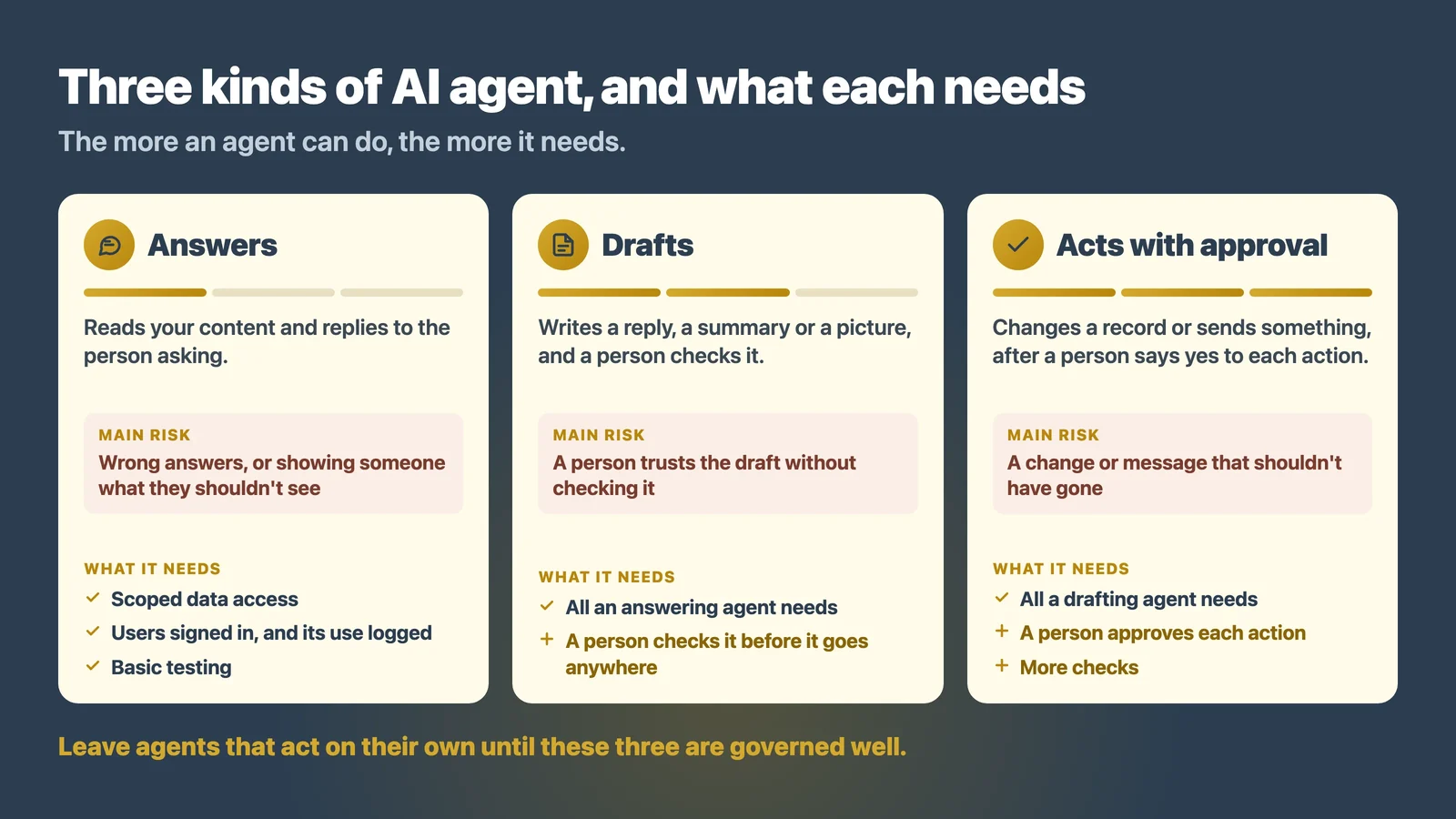
For a smaller organisation, three kinds are a practical place to start:
- An agent that answers. It reads your content and replies to the person asking. The main risks are wrong answers and showing someone what they shouldn’t see.
- An agent that drafts. It writes a reply, a summary or a picture, and a person checks it before it goes anywhere.
- An agent that acts with approval. It can change a record or send something, but only after a person says yes to each action.
Leave agents that act on their own until you’ve governed these three well.
| Kind of agent | Main risk | What it needs |
|---|---|---|
| Answers | Wrong answers, or showing someone what they shouldn’t see | Gartner’s light controls for its simplest level: scoped data access, user authentication, usage logging and basic testing |
| Drafts | A person trusts the draft without checking it | A person checks it before it goes anywhere |
| Acts with approval | A change or message that shouldn’t have gone | A person approves each action, and more checks |
Where agentic AI governance stops and your usage policy starts
AI agent governance and an AI usage policy get mixed up, so it helps to separate them. An AI usage policy covers what your people may do with AI tools: which tools are allowed and what must never be pasted into them. If you haven’t written one, start with what your AI usage policy should include.
Agent governance covers each agent your organisation switches on: its job, its owner, what it can reach and how its use is checked. “Agentic AI governance” is the same idea under another name. Your usage policy can simply point to the agent records. Neither needs to repeat the other.
A one-page record for each agent
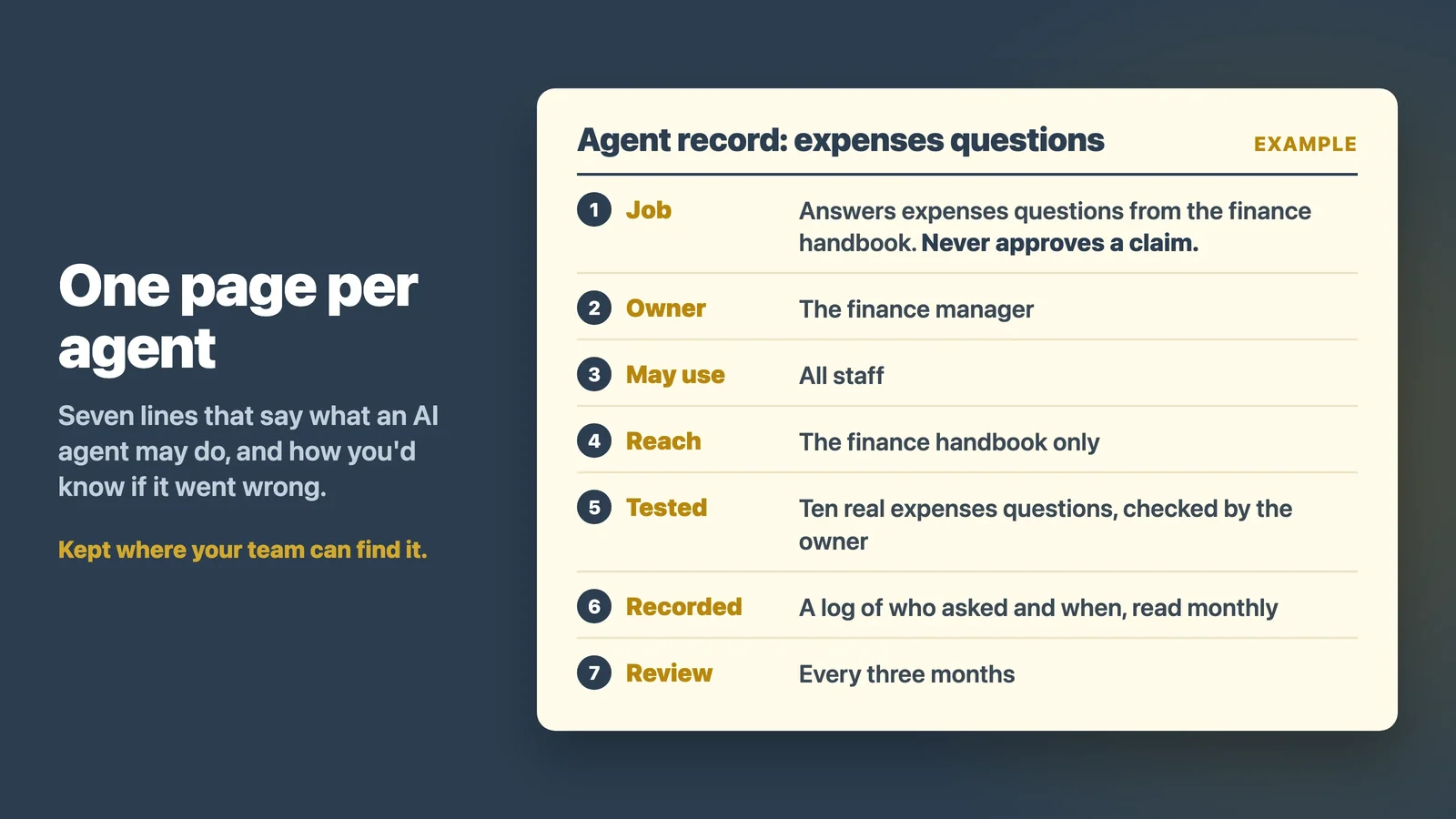
You don’t need a framework document. You need one page per agent, kept where your team can find it. These are the first four lines I’d put on it.
- Its job, and what it must not do. One sentence each. “Answers questions about expenses from the finance handbook. Never approves a claim.”
- A named owner. One person, not “IT”. They answer for its replies, approve changes to its instructions and read its record. If they leave, the agent gets a new owner before anyone uses it again. Otherwise you’ve recreated the one person who holds it all, only this time it’s software.
- Who may use it. Name the teams, groups or roles. A finance agent rarely needs to be open to everyone.
- What it may reach and do. The content, systems and tools it’s given, and nothing more. An agent is only as careful as the permissions behind it. If a folder is open to everyone, an agent that searches it can show people what they were never meant to see. That’s the real risk of AI on your intranet, and it’s worth fixing first.
For example, the expenses agent above might read: Job: answers expenses questions from the finance handbook, never approves a claim. Owner: the finance manager. May use: all staff. Reach: the finance handbook only. Tested: ten real expenses questions, checked by the owner. Recorded: a log of who asked and when, read monthly. Review: every three months.
How you’ll know an agent is behaving
The record’s last three lines, how it was tested, where its use is recorded and when it’s reviewed, are about checking.
- Tested before it’s switched on. Ask the people who’ll use it for ten real questions or tasks. The owner checks every answer before anyone else relies on it. Keep the list, and run it again whenever the instructions or the content change.
- Where its use is recorded. You need a log of who used it and when, and somebody who actually reads it. In a SailPoint report published in May 2025, a survey of 353 IT professionals, 80% said their AI agents had taken unintended actions, such as reaching systems or data they shouldn’t have (SailPoint, 2025). A record is how you find out.
- When it’s reviewed, and when it retires. Set a review date, every three or six months. Agree when it will be switched off: its job ends, its owner leaves with no successor, or its answers drift. Only 7 of the 31 guides I checked use any form of the words retire, decommission or sunset.
Retirement isn’t a formality. In the same May 2026 release, Gartner predicts that by 2027, 40% of enterprises will demote or decommission autonomous AI agents because of governance gaps found only after something went wrong. It’s better to plan the exit than to be forced into it.
Interactive: The agent record
Choose the kind of agent
Write one agent's record
Pick the kind of agent, then what's true today. Gaps show in gold.
The seven lines of the record
What the record is missing
Nothing is sent anywhere.
How many AI agents do you already have?
Agents arrive from several directions: built into software you already pay for, switched on during a trial, or made by a keen colleague one afternoon. Each seems harmless on its own. Together, nobody can say how many there are, who owns them or what they can reach. That’s what people mean by agent sprawl.
So the first act of AI agent governance isn’t a policy. It’s a list. Write down every agent you use or are trialling, where it lives and who switched it on. Agents with no owner go to the top of the list.
When an agent gets it wrong, who answers for it?
The owner, not the software and not the vendor. That’s the heart of AI agent governance, and it stays true even when a person signs off the agent’s work. Gartner warns that even an agent that only advises can anchor a person’s judgement, because people tend to trust its output. So the agent’s owner still answers for the result, whoever signs off each piece of work.
In our own demo portal, we built an agent on a purchase request form and asked it to approve a request. It declined, and the request stayed as it was. That’s the shape to aim for: the agent answers, and a person decides.
When something goes wrong, keep the response simple. Switch the agent off, tell the people who used it, then fix the instructions or the content behind the answer. Run the test questions again before you switch it back on. Teach your team to check an answer against its source before they rely on it, and mistakes get caught sooner.
Managing AI agents: how to start this week
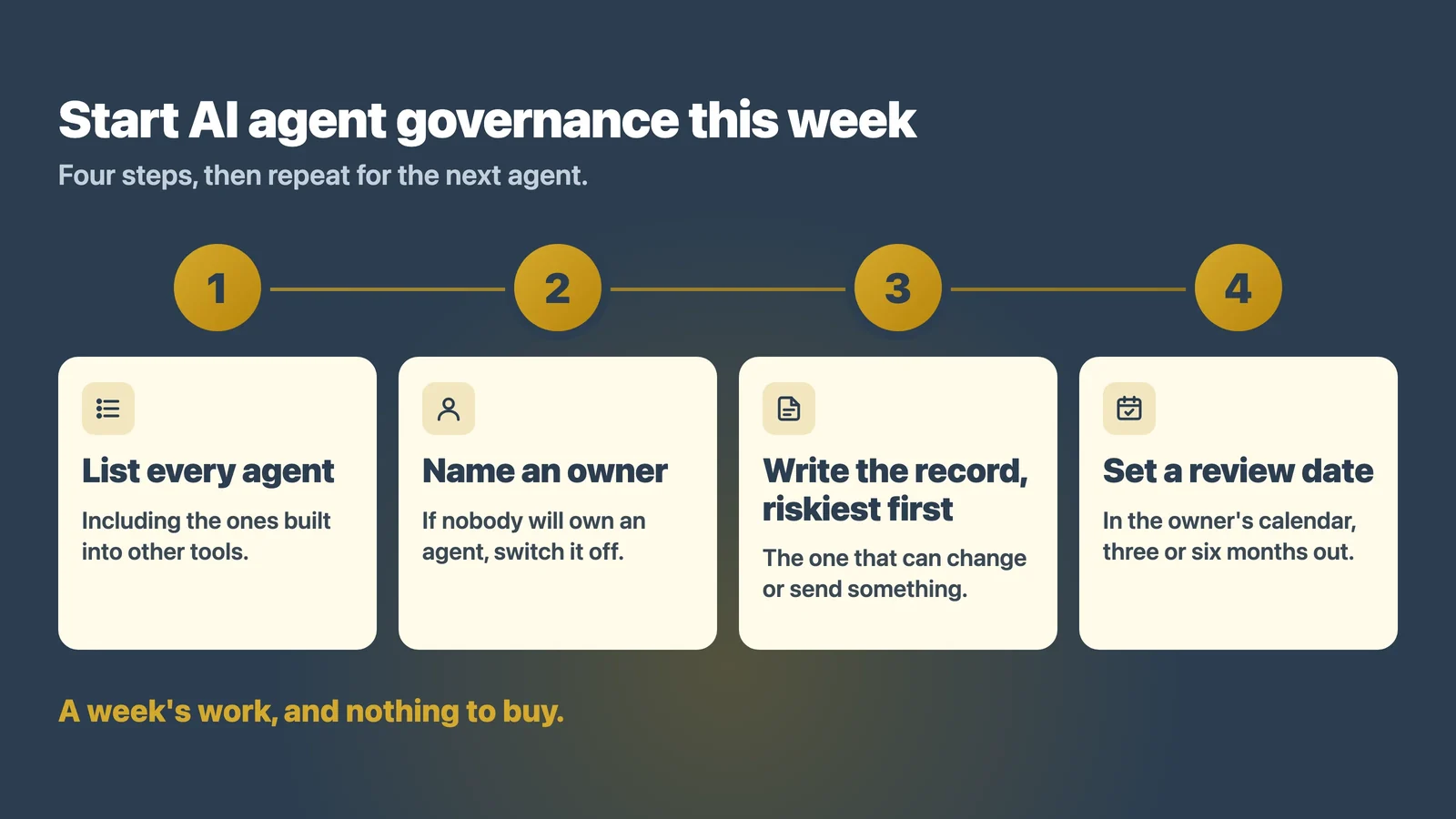
You can start AI agent governance in a week, without buying anything.
- List every agent you have or are trialling, including the ones built into other tools.
- Name an owner for each one. If nobody will own an agent, switch it off.
- Write the one-page record for the riskiest agent first: the one that can change or send something.
- Put a review date in each owner’s calendar, three or six months out.
Then repeat for the next agent. The record grows with your agents, not ahead of them.
Where the intranet fits in AI agent governance
Much of this is easier when your agents work where your content and permissions already live. That’s usually the intranet. We implement Claromentis, so weigh our view with that in mind. In Claromentis, AI agents come with the intranet licence at no extra cost. An administrator chooses who can use each agent, by group or role, and people see only the agents they’ve been given. An agent works within the permissions of the person asking. Agent use is recorded in the intranet’s audit log.
The record’s other lines, the job, the owner, the tests and the review date, are still yours to write. You can see how agents work in Claromentis in more detail.

Frequently asked questions
What are the best practices for governing agents?
Give every agent a written job, a named owner, a list of who may use it, and limits on what it can reach. Test it with real questions before switching it on, keep a record of its use that someone reads, and set a date to review or retire it. Match the controls to what the agent can do.
Who should own an AI agent?
One named person who understands the job it does, usually in the team that uses it, not IT by default. The owner answers for its replies, approves changes to its instructions and reads its record. IT can still manage the platform, but somebody in the business has to own what the agent does.
Does a small business need agent governance?
Yes, but a light version of AI agent governance. If you use one agent that answers questions from your own documents, a one-page record and a named owner may be all you need. The moment an agent can change records or send things, add approval steps, testing and a review date.
How is this different from an AI usage policy?
A usage policy covers what people may do with AI tools, such as what they must never paste in. Agent governance covers each agent your organisation switches on: its job, owner, access and record. You need both. The policy can simply point to your agent records.
Are there agreed principles for governing agents?
Different bodies have published different frameworks. Gartner sorts agents into four autonomy levels with controls for each. Singapore’s Model AI Governance Framework for Agentic AI, launched in January 2026, covers four areas: bounding the risks upfront, keeping humans accountable, technical controls, and user responsibility (IMDA, 2026).
The bottom line on AI agent governance
You don’t need a governance team to govern AI agents well. You need a list of the agents you have, a named owner for each, and one page that says what each agent may do and how you’ll know if it goes wrong. Match the controls to the agent: light for one that answers, more for one that acts. Then set a date to look again.
If you’d like to see these controls in a working intranet before you decide, we’ll set up a free 30-day Claromentis demo playground. If it isn’t the right fit, we’ll say so.