How we chose these 7 platforms
We scored each platform on five things. They decide whether a system still gets used in year three, not just bought in year one. A British SME of 10 to 500 staff rarely has a dedicated learning team. The fit has to suit a busy HR or operations lead, not a full-time administrator.
1. Honest, comparable pricing
Most vendors hide pricing behind “request a quote”, and the ones that publish it count users differently. We favoured platforms with transparent figures. Where you can only get a number by asking, we say so.
2. UK or EU data residency
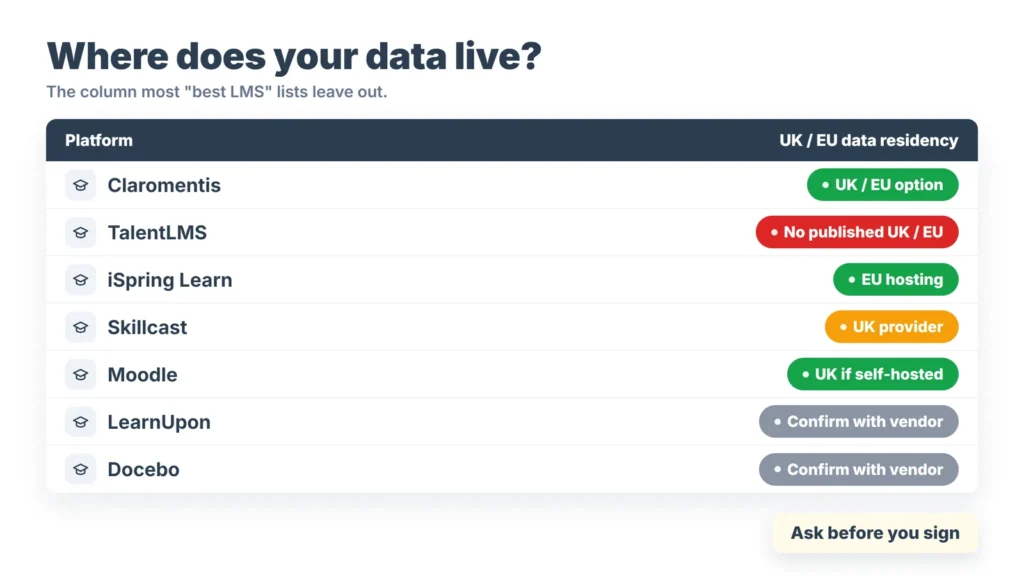
GDPR, ICO registration and sector rules push British buyers towards systems that hold data in the UK or EU. This is the question other lists ignore. So we checked each vendor’s own pages and stated what we found.
3. Adoption by non-technical staff
The platform your least technical manager can run without a manual will beat the most powerful system nobody opens. Adoption beats features, every time.
4. Compliance evidencing
For regulated SMEs, the real job is proving training happened. With 1.9 million working people in Great Britain reporting a work-related illness in 2024/25 (HSE, 2024/25), safety training isn’t optional. We looked at certificates, expiry tracking and audit-ready reports, not just course delivery.
5. Integration with what you already run
A system that connects to your HR tool, Microsoft 365 or intranet saves IT work and lifts completion rates. A separate island does neither.

We’re an Authorised Claromentis Partner, so you can try its Learning module free for 30 days in a working portal.
Which LMS platforms made this list?
In 2026, a UK SME has dozens of credible options. The UK LMS market was worth about USD 1.6 billion in 2025 (Grand View Research, a commercial estimate). The category is growing fast. We narrowed to 7 that genuinely fit the 10 to 500 staff band. Each serves the UK market with a sensible model. We left out pure course-selling tools, the kind built to sell training to customers. We also dropped anything we couldn’t verify on the vendor’s own pages.
The 7 platforms compared below:
- Claromentis (UK partner-led, learning built into the intranet)
- TalentLMS (low-cost, fast self-serve start)
- iSpring Learn (PowerPoint-based authoring, EU data residency)
- Skillcast (UK compliance specialist with a ready course library)
- Moodle (open-source, self-hosted control)
- LearnUpon (mid-market, external-audience training)
- Docebo (AI-first, enterprise-grade)
The 7 platforms at a glance
The table is a starting point, not a decision. The reviews after it explain who each one really fits. Figures are indicative and mix currencies. Some are third-party estimates, not vendor list prices, so always get a written quote.
| Platform | Best for | Indicative year-one cost | UK / EU data residency | Build your own / ready courses | Best fit size |
|---|---|---|---|---|---|
| Claromentis | Learning built into your intranet | Quoted on your scope (platform, modular) | Cloud (Google Cloud) or on-premise; ISO 27001:2022; confirm region | Build your own + SCORM 1.2; no ready library | 30 to 100+ staff |
| TalentLMS | Fast, cheap, light-admin start | from USD 119/month (up to 40 users) | No published UK/EU option | Build your own + AI authoring; SCORM/xAPI | 10 to 100 staff |
| iSpring Learn | PowerPoint-based authoring | from ~USD 3.58 per active user (indicative) | Yes, stored in Europe (AWS) | Strong authoring (iSpring Suite); SCORM | 20 to 200 staff |
| Skillcast | Ready-made UK compliance courses | published tiers, by subscription (quote) | UK provider; confirm data centre | Ready CPD library + your own; SCORM 1.2/2004/AICC | regulated SMEs |
| Moodle | Open-source control, no licence fee | core free; MoodleCloud from ~£120/year (50 users) | Self-host or UK partner for full control | Build your own; SCORM | technical SMEs, training providers |
| LearnUpon | Training customers and partners | quote only; ~£10,000+/year (estimate) | AWS; ISO 27001 + SOC 2; confirm residency | Build your own + AI; SCORM/xAPI | 100+ staff |
| Docebo | AI-first, enterprise-grade | quote only; premium (estimate) | GDPR-compliant; confirm EU/UK residency | Build your own + AI; SCORM/xAPI | larger SMEs, enterprise |
1. Claromentis
Best for: UK SMEs that want an LMS built into the intranet they already run, with a UK partner doing the setup.
Claromentis is a UK-built digital workplace. Its learning module sits alongside the intranet and business process automation in one platform, with one login (Claromentis, 2026). You get course and module management, quizzes and assessments, and reporting dashboards. Certificates auto-generate on completion, with an optional validity period. Compliance pathways send automated reminders (Claromentis course management).
When I ran training across 850+ staff in 20 countries at a healthcare group, the win was never the courses. It was evidencing completion across a regulated workforce without a quarterly spreadsheet chase. That’s what the Claromentis Learning module is built for.
Be honest about the limits. It’s not a specialist authoring tool to rival Articulate or Adobe Captivate. It supports SCORM 1.2 rather than the full standards set. And it ships no off-the-shelf course library, so you supply the content. Hosting is cloud (Google Cloud) or on-premise with ISO 27001:2022. So confirm your region rather than assume a UK data centre.
Pricing: an integrated Claromentis platform is quoted on your scope: how many people use it and which applications you switch on. Your quote can include the Business Process Automation and Learning Management System add-ons. Year two is lower, because installation and onboarding don’t repeat. It also depends on scope: migrating data from an existing system, connecting other systems, and how many workflows and courses you need all move it, so we quote on your requirements.
Verdict: the right call when you’d rather switch training on inside one platform than buy and integrate a separate system. The wrong call if you sell courses or need the deepest standalone feature set.
The learning path screen
 Ask anything
Learning > Learning Paths > View Path
Join this pathEdit
0%Points: 0/25
Path Details Path Steps Participants
+ Add Participants
NameJob TitleProgressDeadline
What the learning path shows
A working model of the real Claromentis Learning Paths screen, checked against the product. The path, steps and people are UK SME sample data. Progress is points earned out of points available, as the product shows it.
Build a path for your own team, free for 30 days2. Talent LMS
Best for: small UK teams that want a working system live this week with minimal admin.
TalentLMS is the affordable default in almost every UK list, and the pricing is refreshingly clear. Core is USD 119 a month for up to 40 users, Grow is USD 229, and Pro is USD 449. There’s even a free plan for up to 5 users (TalentLMS pricing). It has a built-in course builder, AI authoring, and SCORM support, so a non-technical admin can get going fast.
Where it falls short. It’s billed in US dollars, with no published UK or EU data-residency option. So a British buyer carries currency exposure, and takes data location on trust unless they negotiate Enterprise terms. Reviewers on lower tiers also flag shallow reporting and thin support (G2 TalentLMS reviews).
Verdict: strong for general staff training and onboarding at the smaller end. Less suited to regulated SMEs that need deep compliance reporting or a firm UK data-residency answer.
3. iSpring Learn
Best for: SMEs that build a lot of their own content in PowerPoint and want proper EU data residency.
iSpring Learn pairs a straightforward LMS with the iSpring Suite authoring tool. Teams that live in PowerPoint can turn slides into tracked courses quickly. For UK and EU customers, data is stored in Europe, on AWS in Dublin and Frankfurt (iSpring data security). It comes with a DPA and standard contractual clauses. That’s the clearest residency answer in this list.
Where it falls short. It runs a per-active-user model: you invite everyone and pay for those who log in each month (iSpring pricing). If most of your staff log in every month, that can creep close to a per-seat rate. Third-party figures put it around USD 3.58 per active user, an indicative number rather than a list price, so model it against your real usage and confirm the exact rate with the vendor.
Verdict: a sensible pick when authoring volume is high and EU data residency is a hard requirement. The published model rewards occasional learners more than constant ones.
4. Skillcast
Best for: regulated UK SMEs that want an LMS with ready-made compliance courses rather than building their own.
Skillcast is a UK compliance specialist, a London-listed business built around UK regulatory regimes. Its CPD-accredited courses cover anti-money-laundering, GDPR, bribery and health and safety (Skillcast, 2026). It sells in published tiers, Standard, Enhanced and Premium, billed by subscription rather than a public per-user price (Skillcast pricing). It supports SCORM 1.2 and 2004 plus AICC, and lets you upload your own content alongside its library.
Where it falls short. It’s compliance-first by design. So it’s narrower than a general-purpose system for skills and development, and the bundled course library means paying for content you may not all need.
Verdict: hard to beat when off-the-shelf UK regulatory training is the main driver, in financial services, care, legal or charities. Less of a fit if you want one tool for all learning, not just compliance.
5. Moodle
Best for: technically capable SMEs, charities and training providers that want control and no per-seat licence.
Moodle is the world’s most-used open-source LMS. The core software is free. You run it three ways: self-host on your own UK kit, use a UK Certified Partner, or use MoodleCloud. Its standard plans start around £120 a year for 50 users (MoodleCloud plans). Self-hosting or a UK partner gives you full control of where data sits, a genuine residency advantage.
Where it falls short. “No licence fee” is not “free to run”. It needs setup, maintenance, upgrades and either a sysadmin or a partner, and the default interface feels dated. For a small non-technical HR team, the real effort can outweigh a tidy SaaS tool.
Verdict: excellent value and control if you have the technical resource or a good partner. A headache if you don’t.
6. LearnUpon
Best for: growing organisations training external audiences, customers, partners and members, across multiple portals.
LearnUpon is a Dublin-based platform aimed at the mid-market, with multi-portal training and AI-assisted course building (LearnUpon pricing). It’s hosted on AWS and cites ISO 27001 and SOC 2, though you’ll need to confirm UK or EU residency with sales.
Where it falls short. Pricing is quote-only and based on monthly active users, with minimums that start around 100 users. The smallest UK SMEs are effectively priced out, and can’t budget from a public list. Independent estimates put typical contracts in the five-figure range a year. Treat that as an estimate, not a vendor figure.
Verdict: a fair choice once you’re training external audiences at scale. Overkill, and over budget, for a sub-100-staff internal training need.
7. Docebo
Best for: larger SMEs and enterprises wanting an AI-first, highly configurable platform with the budget and admin to match.
Docebo is a Canada-headquartered, enterprise-grade system with strong AI, extended-enterprise features and deep reporting (Docebo, 2026). It’s GDPR-compliant and widely used across the EU. But the public pages name no specific UK or EU data centre, so confirm residency contractually (Docebo on GDPR).
Where it falls short. Pricing is quote-only and sits at the premium end, with real admin overhead. For a typical 10 to 100-staff UK SME, it’s heavier and pricier than the job needs.
Verdict: a serious platform for the top of the SME range and above. It’s the wrong tool if you want something a small team can run without a dedicated administrator.
How do you choose the right platform for your business?
These 7 sort along three axes: cost model, data residency, and standalone tool versus learning inside a platform you already run. The matrix maps the common British SME scenarios to the system that usually fits best.
| Your scenario | Strongest match | Why |
|---|---|---|
| 10 to 50 staff, want it live this week, tight budget | TalentLMS | Low cost, transparent pricing, fast self-serve setup |
| Lots of in-house content built in PowerPoint, EU residency a must | iSpring Learn | Tight authoring plus stated European data hosting |
| Regulated sector needing ready compliance courses | Skillcast | UK CPD-accredited library plus an LMS, little to build |
| Technical team or partner, want control and no per-seat fee | Moodle | Open-source, self-host in the UK, full data ownership |
| Training customers or partners across portals | LearnUpon | Multi-audience portals, built for external learners |
| Top of the SME range, AI and deep reporting, budget available | Docebo | Enterprise-grade configurability and analytics |
| Already run an intranet, want training built in, UK support | Claromentis | One platform and login; learning beside your documents and processes |
One pattern repeats in UK procurement. Buyers compare feature lists and forget the two things that decide it. One is where the data’s held. The other is whether the tool fits how the team already works. Still weighing up whether your business needs a dedicated system at all? Settle that first, then come back to this shortlist. The same logic runs through our guide to the seven intranet platforms we compared. Those integrated options also carry native learning.

What are the most common LMS buying mistakes UK SMEs make?
Three mistakes repeat in British SME training projects. Avoiding them matters more than chasing the best LMS for UK SMEs on features alone.
Paying for seats nobody uses. Per-user pricing punishes you for staff who never log in. If a vendor charges per registered user rather than per active user, you fund dormant accounts every month. Ask exactly how a “user” is counted before you compare two quotes, because they rarely count the same way.
Buying a course-selling platform for internal training. Several popular systems are built to sell courses to customers. If your job is training your own staff, that machinery is cost and complexity you’ll never use. Match the tool to internal staff training, not to a business model you don’t have.
Treating integration as an afterthought. Rollouts fail on hidden costs, weak integration and low adoption far more often than on missing features. A system that connects to Microsoft 365 or your HR tool gets used. One that also automates the admin around onboarding new starters earns its keep. A disconnected island gets abandoned.
How can a UK SME trial an LMS before buying?
The honest way to evaluate the best LMS for UK SMEs is not a 60-minute sales demo. You want a hands-on environment with realistic content, where your team attempts the actual jobs. Assign a course, complete it on a phone, then pull the kind of completion report an auditor would ask for.
Most of these vendors support that. TalentLMS has a free plan for up to 5 users, iSpring and Skillcast offer trials and guided demos, and Moodle lets you spin up MoodleCloud. For Claromentis specifically, Techspire IT runs a free 30-day demo playground. It’s a private environment with sample content and the Learning module switched on. No credit card, no sales pressure, just your team testing it against the scenarios above.
The bottom line for a UK SME in 2026
The best LMS for UK SMEs is the one that fits your size, your data rules and how your team already works. With 1.26 million UK employees judged to have a skills gap in 2024 (DfE, 2025), the case for training is settled. The choice is how to manage it well.
Need ready compliance courses? Skillcast leads. If you build your own and want EU residency, iSpring fits. For full control with technical resource on hand, Moodle is unmatched on price. On speed and a tight budget, TalentLMS is the quickest start. And if you already run an intranet, the strongest value is usually learning built into the wider digital workplace rather than another login. The fastest way to know which side you fall on is a 30-day hands-on test, not a sales pitch.