
TL;DR: Working in silos means the knowledge your team needs sits with one person or one team. Nobody else can reach it. In a small firm the silo is rarely a whole department. It’s usually one person, and you find out the day they’re on leave. The fix starts with habits, not software: a named second person for every job that matters, a written handover, and one place where questions go.
Most advice on silos is written for big companies. Before writing this, I read the pages Google ranks first for “working in silos” and “knowledge silos” in the UK and the US. Twenty-nine of them loaded. Most read like guides for firms with departments, leaders and an HR team, and end in a long list of strategies. Only two mention small firms at all. Not one talks about a handover, or about knowing who to ask. This guide is for the firm where the silo has a name.
Key Takeaways
- Working in silos means knowledge sits with one person or team instead of somewhere everyone can reach it.
- In a small firm, the silo is usually one person rather than a department.
- The quickest test: list what stops when that person is on leave.
- In a 2018 survey of 1,000 US workers, 42% of the knowledge people held in their role wasn’t shared with colleagues (Panopto).
- Fix the habit before you buy a tool: a named second person, a written handover and one place questions go.
Interactive: The holiday test
Could someone else do it next week?
Picture the person who usually does each job away for a week. Answer Yes if someone else could do it, No if nobody could.
Nothing is sent anywhere. If every job has a second person, it says so.
What does working in silos mean?
Working in silos means people or teams work in isolation, so what they know doesn’t reach the rest of the business. The word comes from the farm silo, a tall store that keeps one crop sealed off from everything else. At work, the crop is knowledge: how a job is done, where a file lives, who to call when something breaks.
A knowledge silo is the thing itself, a pocket of know-how only one person or team can reach. Silo mentality is the attitude that can grow around it, where a team guards its own patch. You can have the first without the second. In a small firm you usually do: nobody is hiding anything, it simply never got written down.
Why does working in silos look different in a small firm?
In a big company, a silo is usually a department. Sales doesn’t talk to finance, and two teams build the same report. In a firm of 20 or 80 people, it’s usually one person. The office manager who knows how payroll runs. The person who prices every job. Very often, the owner.
That person isn’t hoarding anything. They’ve been the one who knows for so long that everyone asks them, so nobody else ever learns. It works fine, right up until they’re away.
The research puts a number on it. In a 2018 survey of 1,000 US workers, Panopto found that 42% of the knowledge people hold in their role isn’t shared with their colleagues. If that person leaves or can’t be reached, nobody else can do that part of the job (HR Dive, reporting Panopto’s study).
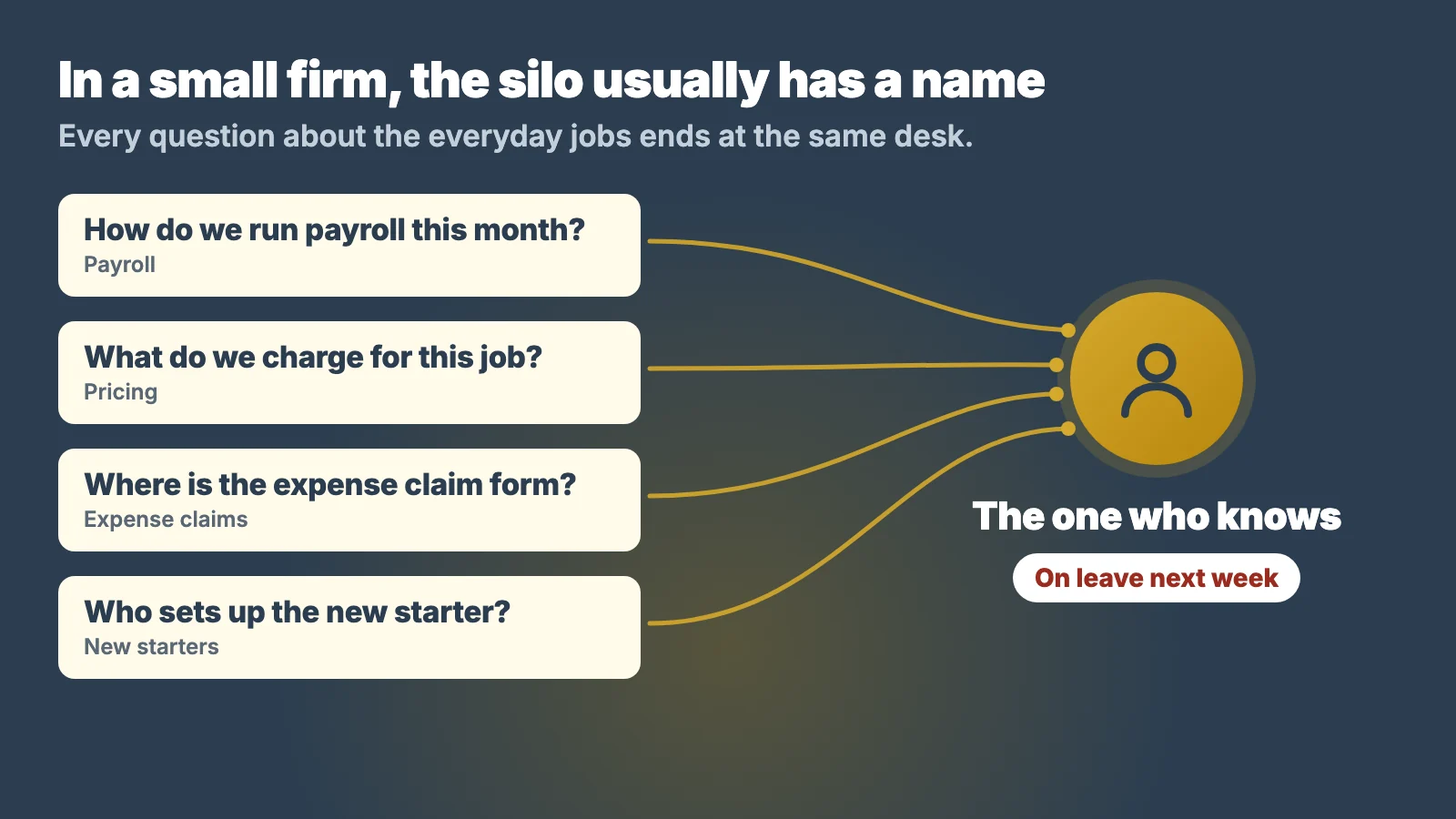
A silo I lived with: people dependent, not process dependent
Before I founded Techspire IT, I managed an intranet used by more than 850 people at a healthcare group. The answers to everyday questions lived in people, not in the system. Sometimes HR had them, sometimes Finance (how to claim an expense), sometimes IT (there was no written guide to setting up two-factor sign-in yourself), and sometimes another employee. So people walked from desk to desk to get answers to common problems. A few policies were current. The travel and maternity policies weren’t, because nobody was named to keep them up to date. When the one person who knew was on leave, it was chaos: the work waited until they came back, or someone guessed wrong and it took days to piece things back together. We were people dependent, not process dependent.
The fix was a process, not a person. Once IT onboarding ran as one request, HR knew to raise it, the manager approved it with the cost, and IT ordered the laptop and software from that same request. The new starter got an email with their login details on day one. Everything was tracked, and if someone was on leave, anyone could pick the request up and carry on.
Why is working in silos bad?
Because the work stops when the person does. A two-week holiday, a sick day or a resignation turns one person’s knowledge into everyone’s problem. Work waits. Questions queue at one desk. Someone guesses, and the guess has to be undone later. The same answer gets worked out twice, by two people who didn’t know the other had it.
That time adds up. Atlassian surveyed 12,000 knowledge workers and 200 executives in 2025. Leaders and teams, it found, lose 25% of their time just searching for answers (Atlassian, State of Teams 2025). In the Panopto study, people lost 5.3 hours a week waiting for information from colleagues, or recreating what already existed.
The person everyone depends on pays as well. It’s hard to switch off when you know the work stops without you. And when they resign, the knowledge leaves with them, with only their notice period to write down years of habit.
How do you spot a silo before it costs you?
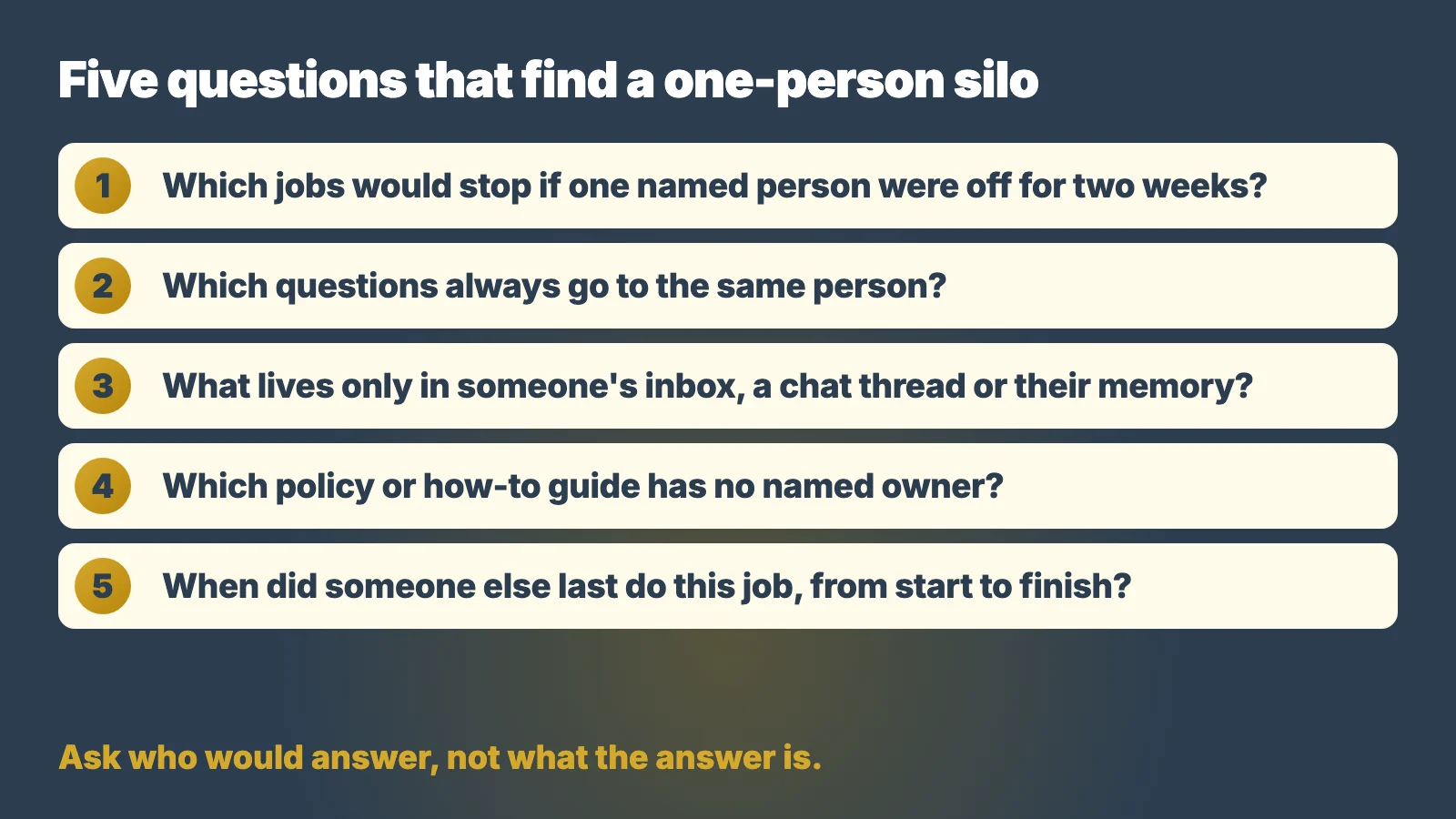
Ask who would answer, not what the answer is. These five questions will find most of them:
- Which jobs would stop if one named person were off for two weeks?
- Which questions always go to the same person?
- What lives only in someone’s inbox, a chat thread or their memory?
- Which policy or how-to guide has no named owner?
- When did someone else last do this job, from start to finish?
If a job has one name next to it and no written steps, that’s a silo. If people walk from desk to desk, or message around, just to find out who knows, that’s a silo too. Try the holiday test above with your own list of jobs: the gaps show up in a couple of minutes.
Why does working in silos start in small firms?
Mostly through growth, not bad behaviour. A business of eight people doesn’t need written steps, because everyone sits together and can simply ask. As the team grows, that stops working, but nobody stops to write things down. The first person to do a job keeps doing it. Answers get given in private messages, where the next person can’t find them. And no one is named to keep a document up to date, so it quietly goes stale.
Notice what’s missing from that list: nobody decided to build a silo. That’s why telling people to “share more” rarely works on its own. It’s the same reason staff ignore policies they can’t find: the problem is where the knowledge lives and who owns it, not people’s attitude.
How do you stop working in silos without buying anything first?
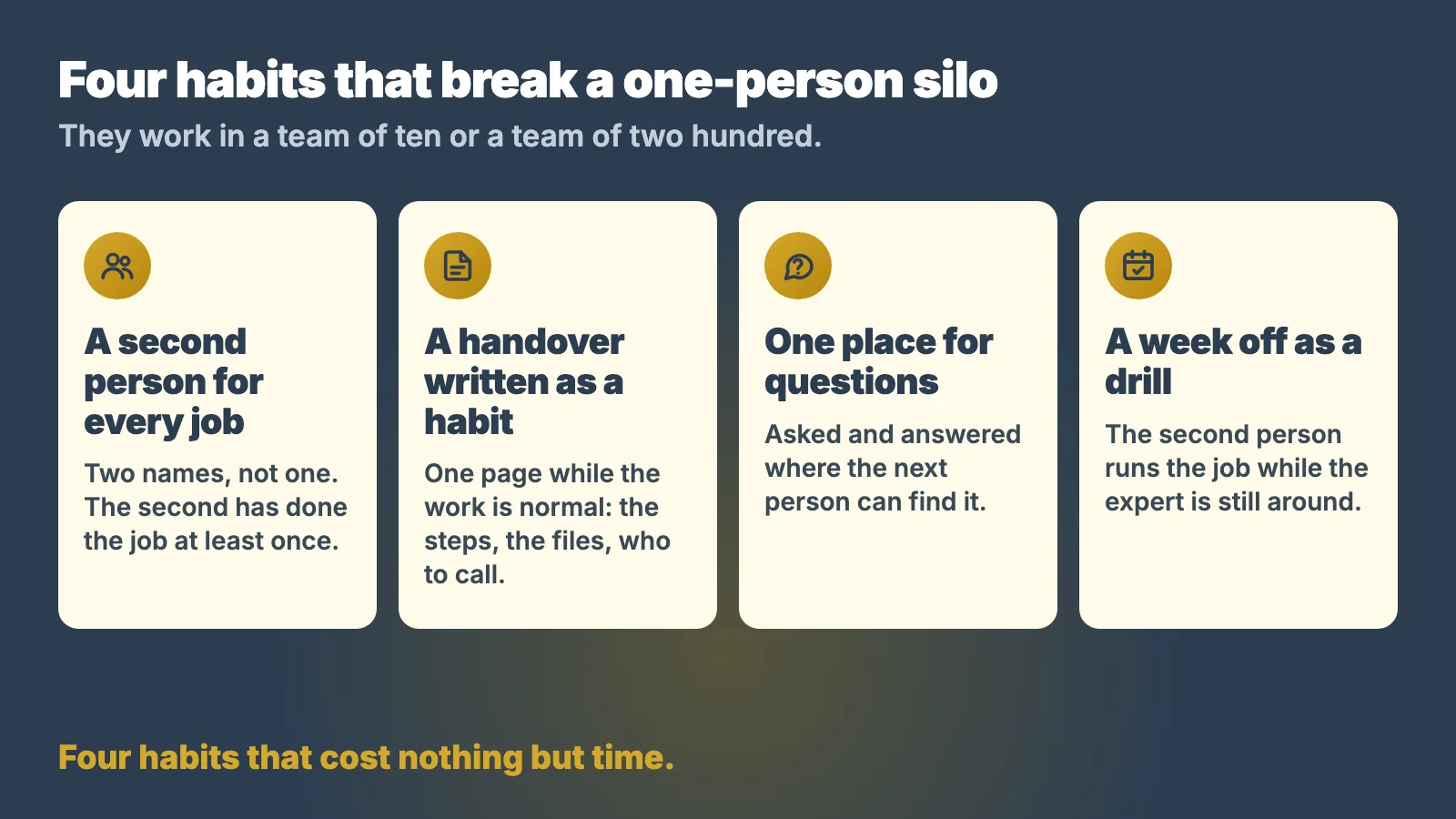
Start with habits. Software can store knowledge, but it can’t decide who owns it. These four habits cost nothing except time, and they work in a team of ten or a team of two hundred.
Name a second person for every job that matters
For each job on your list, write down two names, not one. The second person doesn’t need to be as quick. They need to have done the job at least once, with the first person watching. Swap the order now and then, so the second name stays real rather than becoming a line on a spreadsheet.
Make the handover a habit, not a leaving ritual
Many handovers happen once, in someone’s last week, in a rush. Write them while the work is normal instead. Keep each one short: what the job is, the steps, where the files live, and who to call when it breaks. Update it when the job changes. A one-page note written now beats a ten-page document written during a notice period.
Give questions one place to go
If answers live in private messages, the same question gets asked again next month. Agree one place where questions are asked and answered, so the answer is there for the next person. It can be a shared channel, a page or a folder, as long as someone owns it. This is the idea behind employee self-service: people find the answer, not the person.
Treat a week off as a drill
Before someone’s next planned holiday, ask the second person to run their jobs for a few days while the expert is still around. Whatever they get stuck on is your missing handover note. Fix it then, while it’s cheap, rather than when the expert is unreachable.
When does a tool help with working in silos?
Once the habits exist. A tool can’t fix a job nobody has written down. What it can do is make the habits stick, so they don’t fade the week everyone gets busy. My own story above worked that way round: the process came first, and the system made it stick.
If you’re weighing up a tool, check that it does three things:
- It shows who else knows. You can search people by skill, so a question goes to a list of names rather than one desk.
- It gives every guide an owner and a review date. The handover is written once and kept current, and a question goes to the page, not the person.
- It lets a request move to whoever is free. A request anyone can pick up doesn’t wait for one person to come back from leave.
An intranet is the usual home for all three, because people already open it. An AI knowledge base your staff can ask can then answer from those pages in plain language. Before you buy anything, it’s worth reading why intranet projects stall after launch, because the same habits decide whether a new system gets used.
Inside Claromentis: finding who knows
The People skills search, by expertise and by endorsements
Who else knows Active Directory?
An illustration of the People skills search in Claromentis, redrawn from our demo portal with its sample people, 19 October 2026.
Frequently asked questions
What is the opposite of a silo in a business?
Shared knowledge with more than one owner. In practice, at least two people can do each job that matters and the steps are written down. Questions go to a place rather than a person. Collaboration across teams tends to follow from that, rather than the other way round.
Do silos still exist with modern tools?
Yes. Chat apps and shared drives make it easier to store knowledge, but not to find it or own it. A firm can use the latest tools and still depend on one person to know which file is current. Tools move the silo; habits remove it.
What are the three types of silos?
There’s no single official list. A useful split is: knowledge silos, where know-how sits with one person; structural silos, where teams are organised so they rarely talk; and data silos, where systems don’t share information. This guide is about the first, which is the one small firms usually feel first.
What is an example of a silo in a small company?
The expense claim. Only someone in finance knows the steps, the form and the deadline, so everyone walks over to ask. When that person is on leave, claims wait. Nothing about it is secret. It was just never written down where people could find it.
Is a silo ever a good thing?
Focus can be. Specialists need room to go deep, and not every detail belongs to everyone. The problem starts when the business can’t reach that knowledge without that one person. Deep expertise is healthy. A single point of failure isn’t.
What software helps break down silos in a small company?
You may not need any yet. If the habits above aren’t in place, software just stores the same gaps. Once they are, look for three things: a directory you can search by skill, guides with an owner and a review date, and requests that pass to whoever is free. We implement Claromentis, which does all three, so weigh our view with that in mind and judge it yourself in the free 30-day demo playground.
Who controls a silo?
Usually nobody chose to. The person who holds the knowledge rarely decided to keep it: they’re simply the one who has always been asked. Fixing it is a decision for whoever runs the business. Name the owners, ask for the handovers, and make time for them.
The bottom line
In a small firm, working in silos rarely looks like teams refusing to share. It looks like one person everyone depends on, and the week they’re away. Find those people with the holiday test, give each job a second name and a written handover, and give questions one place to go. That costs nothing but time. When you’re ready for a tool, choose one that gives those answers a home as part of a connected digital workplace.
Run the holiday test on your own jobs. If the same names keep coming up, we’ll set up a free 30-day Claromentis demo playground. Add a few of your own how-to guides, try the people directory, and see whether your team uses it. If it isn’t the right fit, we’ll say so.
Harsh Divecha is the founder of Techspire IT, an Authorised Claromentis Partner, and managed Claromentis at scale (850+ active users across 20 countries) at a multinational healthcare group before founding Techspire IT.
Sources
- Atlassian, State of Teams 2025 (a survey of 12,000 knowledge workers and 200 executives; “leaders and teams waste 25% of their time just searching for answers”), retrieved 2026-10-19, https://www.atlassian.com/blog/state-of-teams-2025
- Panopto, Workplace Knowledge and Productivity Report (2018, a survey of 1,000 US workers: 42% of institutional knowledge is unique to the employee in their role and not shared with coworkers; knowledge workers lose 5.3 hours a week waiting for information from coworkers or recreating information that already exists), as reported by HR Dive on 18 July 2018, retrieved 2026-10-19, https://www.hrdive.com/news/inefficient-knowledge-sharing-costs-large-us-businesses-47m-a-year/527892/ (Panopto’s own release no longer loads)
- Techspire IT first-party results capture. Methodology: the first ten Google results for “working in silos” (UK and US) and “knowledge silos” (UK and US) were captured through DataForSEO on 9 and 19 October 2026, at depth 20 with People Also Ask and the AI Overview. Forum, video, social and encyclopedia results were left out. The 29 pages that loaded were read for their headings and searched for set phrases. Small firms appear on two, a handover on none, and knowing who to ask on none.
- First-hand: the author’s experience managing an intranet of more than 850 users at a multinational healthcare group, told on 19 October 2026.