You probably don’t need one yet if your business is small, your training is informal and occasional, and a shared folder plus the odd workshop genuinely covers it. There’s no shame in that. An LMS solves a management problem. If you don’t yet have the management problem, the software is premature.
The honest test is simple. Can you, right now, produce a report showing which staff completed which training and when? If yes, you may not need an LMS. If that question makes you reach for a spreadsheet and a sinking feeling, that’s the gap an LMS fills.
Where training admin overlaps with wider business process automation, the two often run on the same workflow tools.

How much does an LMS cost a UK SME?
Most LMS platforms charge per user per month, so the headline cost scales with how many staff you enrol. UK SMEs typically see pricing in the low single-digit to low double-digit pounds per user per month, depending on features, with some vendors charging only for active users in a given month. As a rough guide, a 50-person team on a mid-market LMS at around £5 per user per month works out near £3,000 a year, before any setup or content costs. The licence, in other words, is rarely the part that hurts.
If the LMS is one module inside a wider platform rather than a standalone tool, price it as part of that platform. For an integrated Claromentis digital workplace, the price follows your scope: how many people use it and which applications you switch on. Year two costs less because installation and onboarding don’t repeat. Your quote can include the Business Process Automation and Learning Management System add-ons. Learning is one of those add-ons, so your figure depends on headcount and which modules you run. It also depends on scope: migrating data from an existing system, connecting other systems, and how many workflows and courses you need all move it, so we quote on your requirements. For a number against your own team, see Techspire IT pricing or book a demo.
The real cost isn’t the licence
The real cost sits elsewhere: the time spent loading content, getting people to actually use the system, and the waste if staff find it clunky and quietly abandon it. With UK training budgets tighter than they were, £1,700 per employee in 2024, down from £1,960 in 2022 (GOV.UK Employer Skills Survey, 2024), software that goes unused is the most expensive mistake you can make. The cheapest LMS is the one your people will actually use. Adoption beats features, every time.
What about compliance and mandatory training?
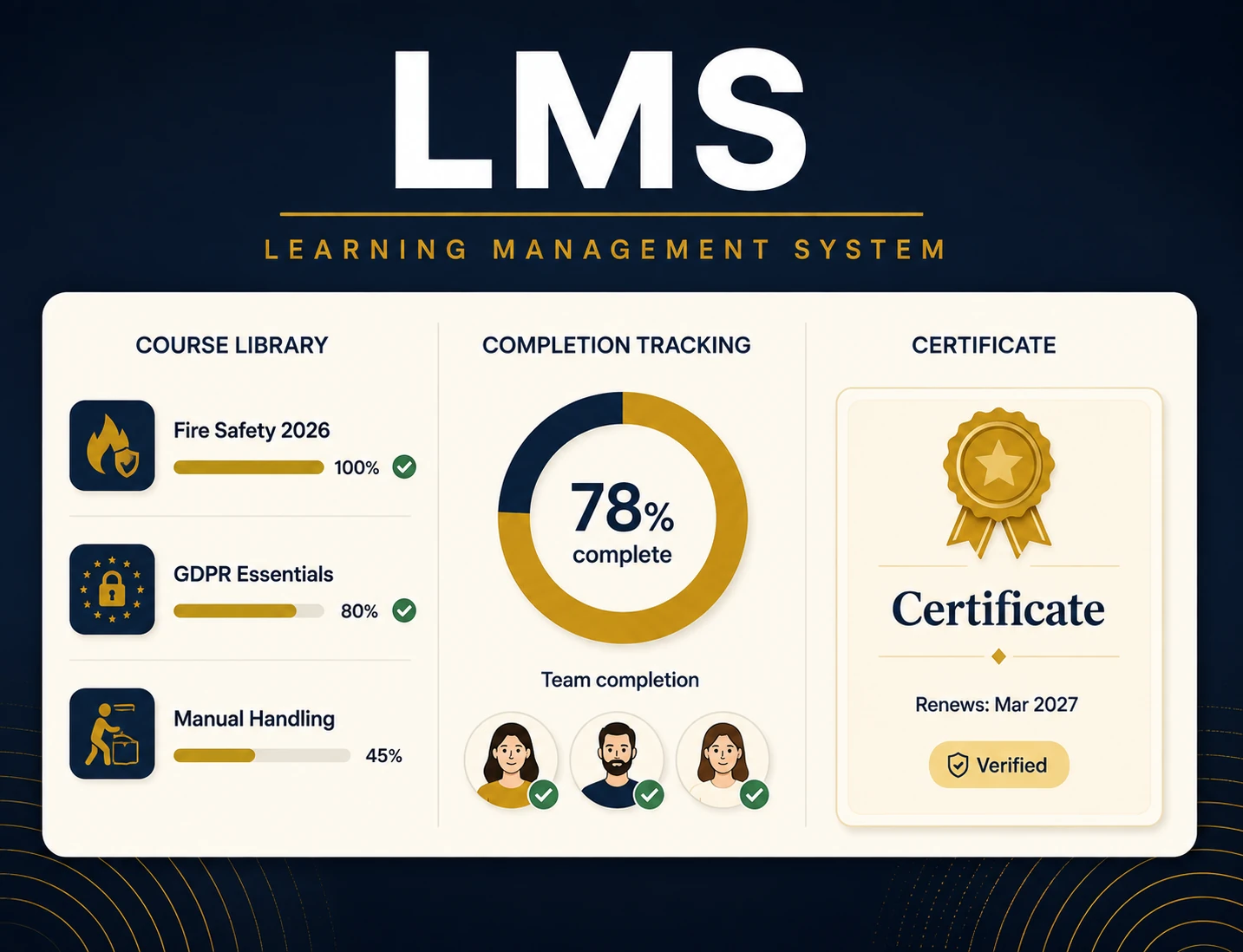
For regulated UK SMEs, compliance is usually the strongest single reason to adopt an LMS, because it turns “we think everyone’s trained” into “here’s the report that proves it”. A system that stores training records, tracks certification expiry, sends automatic reminders and generates audit-ready reports removes the manual risk that someone’s mandatory training has quietly lapsed.
This is where the stakes are real. In healthcare, finance, manufacturing and any sector with statutory training duties, a missed or unrecorded certification isn’t a minor admin slip, it’s a compliance exposure. An LMS makes the records continuous and retrievable rather than scattered.
It’s also the area where I’d push back hardest on doing without. If your SME has any mandatory training obligation, the manual approach doesn’t just cost time, it carries risk that grows with every new starter. That’s the clearest “yes” in this entire guide.

The enrolments register screen
 Ask anything
Onboarding Training (OBC)
LiveAn e-learning course to guide you through the first few stages of creating your intranet.
What the enrolments register shows
A faithful model of the Claromentis Learning enrolments register, built from the real screen. Staff names and dates are sample data; the screen, its columns and its buttons are the product. Not a live system. The real one is in the free 30-day demo.
Standalone LMS, or built into your intranet?
For many UK SMEs, the better answer isn’t a separate LMS at all. It’s learning management built into the intranet and workflow platform you already run, so training lives alongside your documents, news and processes rather than in yet another login. A query about a policy can surface the related training course in the same search. Onboarding a new starter can trigger their induction courses automatically.
The case for a standalone LMS is strongest if training is your core product, for example if you sell courses to customers, or if your learning needs are unusually advanced. For internal staff training at a typical UK SME, a separate system often becomes one more disconnected tool, which is exactly the fragmentation most businesses are trying to escape.
Here’s the practical difference:
| Factor | Standalone LMS | LMS built into your intranet |
|---|---|---|
| Logins | A separate system and login | One login with your intranet |
| Where training sits | Apart from your documents and policies | Beside the documents and policies it relates to |
| Onboarding | Set up and assigned separately | Can trigger from a new starter’s account |
| Search | Searches courses only | One search spans policies, documents and courses |
| Admin | Another tool to manage | One admin panel |
| Best for | Selling courses, advanced L&D needs | Internal staff training at a typical UK SME |
This is the approach we take with Claromentis 11: the LMS is one module inside a single platform, so a business can switch it on when it needs it without buying and integrating a separate product. One login, one admin panel, training included rather than bolted on.

How do you choose an LMS for a UK SME?
Choose on adoption first, features second. The platform your least technical employee can navigate without training-on-the-training will deliver more than the most powerful system on the market. Beyond that, run any shortlist through five practical checks.
- Compliance reporting. Can it evidence completion and certification, with renewal reminders, in a report you’d be comfortable handing an auditor?
- Ease of use. Can a non-technical manager assign a course and read the dashboard without a manual?
- Mobile access. Can staff learn from a phone, which matters for field, shift and remote workers?
- Does it connect to your HR system and intranet, or is it another island?
- UK fit. Is your data held appropriately, and is support available in UK business hours?
The bottom line for UK SMEs
An LMS is a management tool, not a magic one. It earns its place when you have training that repeats, training you must prove, or teams you can’t gather in one room. If that’s you, the question isn’t whether to adopt learning management, it’s whether to buy a separate system or switch it on inside the platform you already run.
For most UK SMEs, the integrated route wins: one login, training included, and learning that connects to the rest of your digital workplace rather than sitting in isolation. Start from the management problem you actually have, choose for adoption over features, and an LMS becomes one of the highest-return pieces of software a growing UK business can run.
For the bigger picture, see how the modules fit together across the Claromentis digital workplace.
See it on your own training before you decide. We’ll set up a free 30-day Claromentis demo playground with the Learning module live, so you can load a course, assign it, and pull the kind of completion report an auditor would ask for, using your own team.